
Billing for Paralegal and Staff Work:
What Law Firms Can Charge and How to Make It Stick


Your client sees “Paralegal work: 2.4 hours” on an invoice. Do they understand that charge or question it?
That answer depends on more than the billing rate charged. Paralegal time can be billable, but only when:
- The work itself is billable
- The rate is reasonable
- The time entry description is clear
Get any of those wrong, and a legitimate fee can quickly turn into a billing question, write-off, write-down, or client dispute.
This guide walks through how to set paralegal billing rates, separate billable from non-billable work, and build time entries that are easier to defend if questions come up.
Why Paralegal Time Can Be Billed Separately
The Supreme Court addressed the value of paralegal work in the Missouri v. Jenkins ruling. The Court maintained that paralegal services could be compensated at fair market rates as part of a statutory attorney’s fee award instead of being limited to the law firm’s cost of employing the paralegal.
That ruling helped establish where the line is drawn. It held that:
- Substantive paralegal work carries its own billable value when it contributes to a lawyer’s work
- Paralegal work can be accounted for separately, not just in the lawyer’s hourly rate
That’s good news for law firms who want to lower the cost of providing legal services to clients and save attorney time for work that requires their judgment and expertise. Delegating specific tasks to a trained paralegal can accomplish both.
But the American Bar Association Model Rules further clarify the ethics and requirements firms must follow around nonlawyer staff work.
Model Rule 5.3 requires any lawyer with supervisory authority to make “reasonable efforts” to oversee nonlawyer staff work and ensure it’s compatible with the lawyer’s own professional obligations.
That means lawyers are responsible for supervising any paralegal work, even when it’s performed independently.
Model Rule 1.5 covers the fee and pricing side of the equation. Lawyers cannot charge an unreasonable fee, and that fee should be based on factors like time and labor required, local market pricing trends, and lawyer experience.
Lawyers are also required to communicate any fees or expenses clearly to the client, usually in writing.
So, the understanding is that law firms can bill paralegal time separately when the work is substantive as long as they supervise it appropriately, charge a fair price, and outline the charges to clients upfront in the engagement letter.
In your firm, billing paralegal work starts with understanding which tasks are and are not considered billable, what a reasonable fee looks like in your local market, and the best way to communicate those charges to clients. That’s what we’ll look at next.
What Are Paralegal Billable Hours?
Not all paralegal work is considered billable at a paralegal rate. The Missouri v. Jenkins decision described which paralegal tasks can be charged as billable hours and which are considered non-billable administrative overhead.
That ruling held that billable hours must involve substantive legal work that makes use of the paralegal’s training, education, and experience. Tasks like legal research, discovery support, factual investigation, drafting, and document preparation may be billable here.
What should not be billed at a paralegal rate are any “clerical or secretarial tasks…regardless of who performs them.”
That may include tasks like filing, organizing, or scheduling, which are considered administrative and should never be billed as paralegal time.
Billable paralegal tasks may include:
- Case research and discovery support
- Drafting legal documents
- Court-related work and preparation
Non-billable paralegal tasks generally include:
- Scanning or copying documents
- Organizing or indexing case files
- Scheduling or confirming appointments
Beyond Non-Billable: What Paralegal Time Should Not Be Billed
Even billable paralegal work can create ethics issues if the same time or task is charged more than once. ABA Formal Opinion 93-379 states that hourly bills should reflect the time actually spent on that client and should not include any general overhead costs unless a different billing arrangement has been disclosed.
Otherwise, those charges may be considered unreasonable.
Avoid these common billing mistakes when charging paralegal hourly rates:
- Billing two clients for the same time: If a paralegal performs work for more than one client during the same hour, your firm should not charge each client for the full hour.
- Billing attorney and paralegal time for duplicative work: If both a lawyer and paralegal attend the same meeting or review the same material, each charge should reflect independently necessary work, not just their attendance.
- Billing administrative overhead: Routine administrative costs or office overhead should not be billed as paralegal services.
- Billing internal supervision as client work: Law firm meetings used to assign or supervise paralegal work do not represent substantive legal work for the client and should not be billed.
Legal time tracking tools that allow you to start and stop multiple timers can help lawyers and paralegals accurately track how much time is spent on each client, task, and separate administrative work to avoid unreasonable charges.
Knowing what constitutes billable hours for paralegals is a start, but it still leaves the question: How much should we charge? To support paralegal fees to a client, you must be able to show you’re charging a reasonable market rate.
How to Determine the Paralegal Billing Market Rate
A market-based paralegal billing rate starts with what comparable firms in your area are charging for similar work. But multiple factors will affect the market rate you set: paralegal experience, paralegal average pay in your market, education level, and your geographic region should all be considered.
Find the Average Paralegal Billing Rate
Determining the market rate may feel like making an educated guess, but looking for recent survey data from local or national paralegal associations can give you a starting point and help avoid underbilling or setting rates too high.
For example, national paralegal organizations like the National Association of Legal Assistants (NALA) conduct annual surveys on paralegal market rates by region and firm size. Their 2024 National Utilization & Compensation Report found a nationwide average paralegal billing rate of $134/hour.
Ideally, your firm can utilize both local and national data, combined with paralegal education and experience, to set a fair and reasonable market rate.
Knowing how to benchmark law firm billing rates is what separates an arbitrary number from a defensible one. A practical benchmarking process looks like this:
- Pull NALA national compensation and utilization data for paralegal average pay and billing rates in your firm size band.
- Layer in state and local bar or paralegal association surveys.
- Adjust for specialty practice areas (for example, a commercial real estate paralegal often bills above the general paralegal rate).
- Compare against virtual paralegal rates if your firm uses contract or remote paralegal support.
- Review the data annually and update your paralegal services price list accordingly.
Check the Rate Against Your Costs
Once you have a reasonable range to work with, check the rate against your actual cost.
Market data can tell you what other firms are charging for paralegal work, but only a cost-plus calculation can tell you whether that rate will be a financially sound move for your firm.
Use this formula to run a cost-plus calculation:
(Paralegal salary + Benefits + Share of overhead) / Realistic billable hours = Cost per billable hour
Here’s how that calculation could look if your firm pays a paralegal a $65,000 salary, $18,000 in annual benefits, and finds their share of the firm’s overhead is $17,000 when the firm expects to record roughly 1,200 billable hours this year.
($65,000 + $18,000 + $17,000) / 1,200 = $83 per billable hour
From there, you can apply your firm’s target margin and compare the rate with your local market data before setting the final paralegal hourly rate.
If your firm targets a 40% margin, you would divide that $83/hour cost by 60%, the portion of revenue left after the target margin. That produces a target billing rate of about $138/hour.
Adjust for the Value and Complexity of the Work
Not every paralegal task brings the same value to the table. If a paralegal is performing highly specialized work, has an advanced certification, brings years of experience, or is supporting a complex matter, a higher rate may be justified.
No matter what, the fee has to remain reasonable and be disclosed to the client appropriately under ABA Model Rule 1.5.
How to Decrease Your Admin Work by 50%
Where the hours go in a small firm, and which of them can be delegated or automated instead of absorbed.
Get the GuideBuild a Paralegal Services Price List
Creating a simple paralegal services price list can help your firm consistently apply the right rates across matters and make those rates easier to communicate to clients.
Your price list doesn’t need to assign a different price to each individual task a paralegal might perform. Instead, it can establish your firm’s approved rates by staff role, experience level, or type of legal work.
Here’s an example paralegal billing cheat sheet for reference.
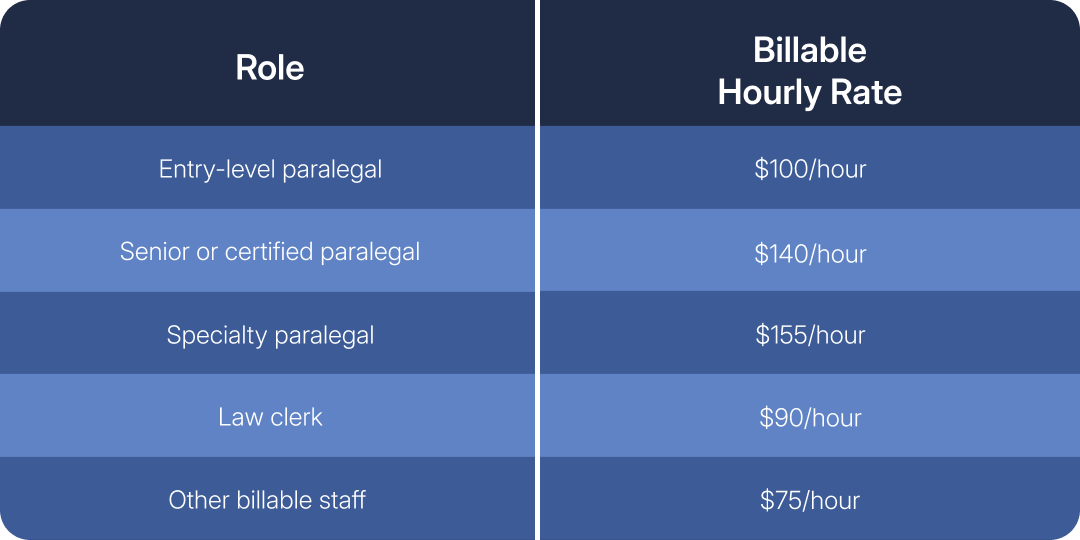
If you’re a midsize law firm in Philadelphia, you might review local survey data and find that average paralegal billing rates in your region are $120/hour. Using that illustrative example, you could set an entry-level paralegal’s billing rate at $100/hour, while billing a senior or certified paralegal at $140/hour. A legal assistant or project manager might bill time at $75/hour.
Make Paralegal Time Entries Easier to Defend
A paralegal’s billing rate may be reasonable and applied only to substantive legal work, but clients can still question the charge if the time entry doesn’t clearly show what work was performed.
The stronger approach is to make each time entry answer three questions:
- What was done?
- Why was it necessary?
- What did it produce or move forward?
If your entries can answer all three, the client has enough context to understand the value of a paralegal’s work.
Standardizing your time entries can help keep client disputes and questions to a minimum:
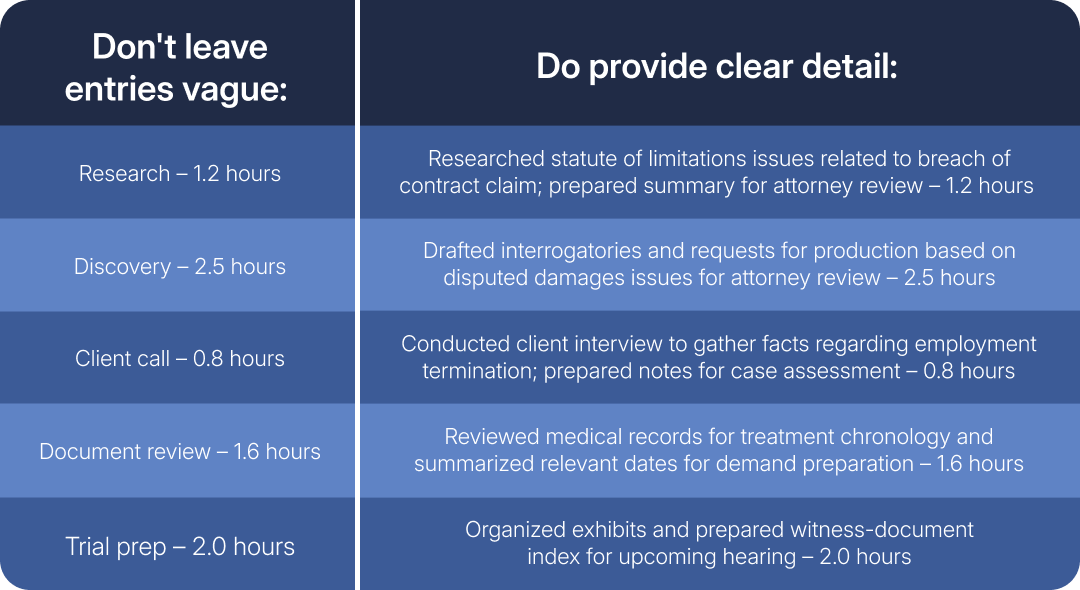
- Use specific descriptions. Replace vague phrases like “Research” with the actual legal task performed.
- Connect the task to its purpose. Explain what issue, filing, request, or client need the work directly supported.
- Show the result when useful. Note what was drafted, summarized, prepared, or completed as a result of the billed time.
- Use consistent billing increments. Many firms bill in six-minute increments, but whatever your firm uses, apply it consistently.
- Avoid block billing. Keep independent tasks separated instead of combining several billable activities into one large time entry.
- Use legal time tracking tools. Capture paralegal time as work happens and keep each entry tied to the right client or matter so descriptions are easy to apply.
If a client does have a question about billing later, descriptive entries give your firm a much stronger record to point back to.
And if the question is about the paralegal rate itself, be prepared to provide the paralegal’s qualifications, the market basis for the rate, and why the work was appropriate to delegate rather than perform at an attorney rate.
Paralegal Time Entry Dos and Don’ts
Apply the Right Paralegal Rates to Every Matter
The next step is making your firm’s paralegal rates easy to apply every time without asking staff to remember exceptions or billing rules as they enter time.
Legal practice management software like CosmoLex can help you standardize paralegal pricing and ensure each matter and task has the proper rate applied.
CosmoLex lets you set default billing rates by timekeeper, so paralegals, law clerks, lawyers, and other billable staff can start with the correct rate already attached to their time. If a client or matter calls for something different, multiple rate levels let you apply that exception without changing the timekeeper’s standard rate everywhere else.
The same idea carries into the time entry itself. Saved tasks, clear descriptions, billing status, and e-Billing task codes help your team create entries that are more consistent and easier to review before invoices go out.
Billing rate and timekeeper reports give you an additional checkpoint, so you can catch an unexpected rate or entry before it gets to the client.
Your firm sets the billing standard once. CosmoLex helps keep it in place through every entry, matter, and invoice.
Start Billing Paralegal Time with More Confidence
Knowing how to set clear, reasonable rates and create stronger time entries makes paralegal hourly rates easier to explain, review, and defend.
Good billing standards pay off every time an invoice goes out with fewer objections, write-downs, and inconsistencies to slow your firm down.
CosmoLex helps you put those standards into practice across every matter. See what billing looks like when you can focus more on the practice, less on the process.
Get started now with a free 10-day trial.
This article provides general information only and is not legal or ethics advice. Check your state bar rules and applicable fee-shifting case law in your jurisdiction.
Frequently Asked Questions
Can a law firm bill for paralegal time?
Yes, when the paralegal performs substantive legal work under proper supervision at a reasonable market rate. Clerical or secretarial work are generally considered non-billable.
Can paralegals bill for clerical work?
Generally, no. Clerical tasks like copying, filing, scheduling, and routine administrative work are typically treated as firm overhead, not billable or substantive legal work.
What is a typical paralegal billing rate?
NALA’s 2024 National Utilization & Compensation Report found a nationwide average paralegal hourly billing rate of $134/hour. Actual rates vary by your local market, paralegal experience, specialization, firm size, and the nature of work performed.
How should law firms set paralegal billing rates?
Start with current national and local market data, then compare those rate benchmarks with a paralegal’s own experience level and your firm’s fully loaded cost per billable hour with a cost-plus calculation. The final rate should be reasonable and appropriate for the work performed.
Do paralegal rates need to be disclosed in the engagement letter?
Firms should clearly communicate how paralegal and other non-attorney staff time will be billed upfront, and the engagement letter ensures these rates are disclosed upfront in writing for defensibility. Check your jurisdiction’s specific requirements.
Bill paralegal time with the detail clients accept
CosmoLex keeps timekeeper rates, matter budgets and billing detail in one place, so staff time is captured at the right rate and reads clearly on the invoice.
Book a Demo

