
Where Automation Belongs in the Law Firm Client Intake Process


Should a robot handle the moment a prospective client decides whether to trust your firm with their case? According to the CosmoLex 2026 Legal Tech Report, that’s not what solo and small firms are asking for.
What many do want is less manual work inside the intake process.
They’re interested in automating the administrative steps that don’t require a lawyer’s judgment, but not the conversations that actually build and strengthen client relationships.
The solution, then, is balance. Automate the repetitive steps and keep the client-facing moments human. How does that work in a solo or small law firm?
Using this year’s report data, we created a step-by-step intake checklist around where surveyed firms see the most value in automation and where they still rely on the personal touch.
How Solo and Small Firms Feel About AI and Automation in Intake
The CosmoLex 2026 Legal Tech Report found that firms are interested in making intake more efficient with AI and automation, but not at the expense of the client relationship.
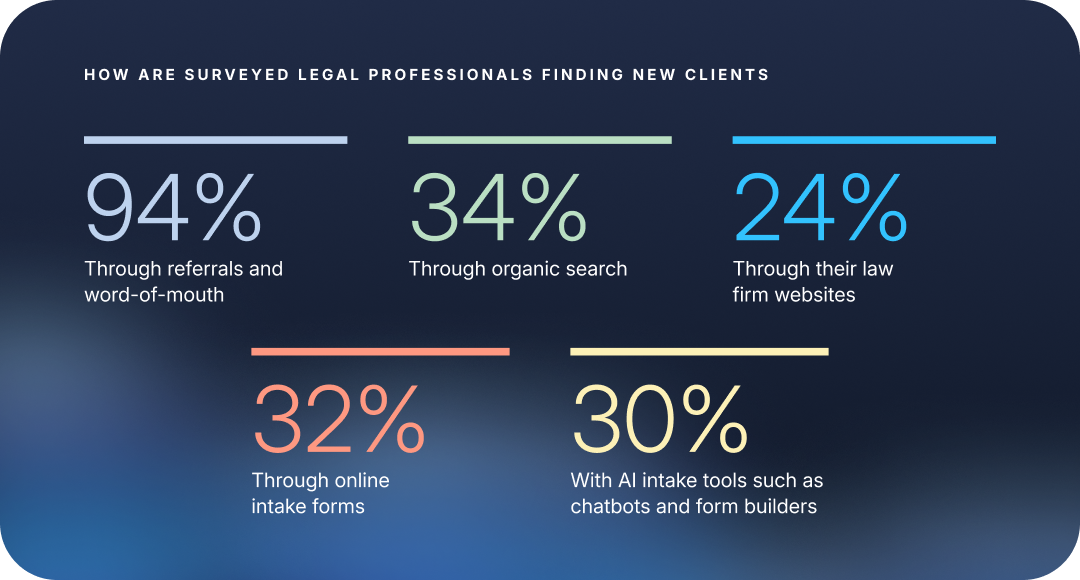
So how are surveyed legal professionals finding, communicating with, and onboarding new clients today? Most still rely on traditional client acquisition methods, like referrals and word-of-mouth, but a number are now experimenting with tools that at least partially automate steps of the intake process.
Among participants:
- 94% cited referrals and word-of-mouth as important lead sources
- Organic search (34%) and law firm websites (24%) were also lead sources
- 32% are using online intake forms to collect prospect information
- 30% have tried using AI intake tools (chatbots, form builders)
Some participants believe automation will make the process more convenient for clients. One noted, “We think using AI during the intake process would make it less frustrating for clients.”
But others are wary of giving technology too much say in the process, with one respondent explaining, “We are concerned about abdicating decision-making responsibility and judgment to machines.”
The findings suggest that firms are open to using technology to make the process easier behind the scenes without making it feel impersonal or giving full control to technology.
What Surveyed Legal Professionals Do—and Don’t—Want to Automate
When asked about which tasks they would most like to eliminate with AI, participants often named key administrative steps that appear throughout the intake process:
- Calendaring and time entry: 12%
- Data entry: 10%
- Drafting correspondence: 8%
And participants saw the most future value of AI for legal work in tasks and processes like these:
- Client communications: 32%
- Client intake: 28%
- Conflict checks: 24%

Nearly two-thirds of surveyed legal professionals (62%) also said it’s very important or essential for intake data to automatically flow into newly created matters, conflict checks, and billing, mainly as a way to reduce manual re-entry errors.
As one participant added, “Automated data transfer eliminates the potential risk of human error associated with reentering information.”
From automatic data flow and scheduling to capturing prospect details from intake forms and following up, surveyed firms do see the value in automating parts of the intake experience.
Where respondents become more cautious is when automation starts replacing the human interaction itself.
Asked about their primary barrier to fully automating intake, CosmoLex 2026 Legal Tech Report respondents cited concerns about accuracy (50%), confidentiality (44%), and client perception (36%). One respondent noted, “Our client demands a human touch.”
Another explained that automation can’t replace a person’s understanding of context and nuance during conversations with potential clients, stating, “You often ask a client a question, and they answer, but an AI tool typically cannot recognize body language that would prompt a follow-up question.”
Automate the Repetition, Not the Relationship
Should parts of intake be automated? Many surveyed firms see opportunity there. Should every step be? Not necessarily.
A useful way to draw the line is to look at what each stage of the law firm client intake process actually requires.
- Is it repetitive?
- Is it rule-based?
- Is it primarily about moving information?
Those steps are where automation can take on more of the work.
Conversely, if an intake step depends on judgment, context, or building trust with a potential client, a person should lead it.
Legal Client Intake Checklist: What to Automate and Keep Human
Use this client intake checklist to see how that balance can work from the first inquiry through the creation of a new matter.
1. New Inquiry: Automate
Use AI-powered intake tools to automate what happens after the first inquiry: capture basic information via the intake form, confirm the inquiry was received, and route it to the right person or team.
Automation helps ensure potential clients get a fast response and confirmation while the responsible team can start reviewing their form sooner.
2. Lead Qualification: Human-Led
Digital intake forms can help collect the right information from leads to aid in sorting or screening them, but the final determination on fit requires human context and judgment.
3. Scheduling: Automate
When your firm is ready to move forward with a prospect, AI-powered intake tools allow you to link lawyer calendars so prospects to choose an available time slot for a consultation.
Automating this step helps reduce unnecessary back-and-forth around choosing appointment times so your firm can meet with potential clients sooner.
4. Consultation: Human-Led
This is where human connection matters the most: your first substantive conversation with a prospect. A lawyer or staff member can use this time to ask follow-up questions, read tone and body language, and assess for fit beyond initial form responses.
5. Conflict Check: Automate
Using intake automation tools, the conflict check can run using prospect information that has already been collected.
Automation handles the data transfer and initial search, but potential conflicts still go through a round of human review before your firm moves forward.
6. Engagement and Follow-Up: Automate
Routine engagement letters, signature requests, meeting reminders, and follow-up messages can move automatically once your firm decides to proceed.
Direct outreach is still best when a prospect has specific questions or concerns, needs reassurance, or would benefit from a more personal conversation.
7. Create New Matter: Automate
Once a client retains your firm, their information should carry directly into the new matter, conflict records, billing, and other workflows downstream.
Automatic data flow helps prevent staff from re-entering details in multiple systems or making errors when keying information in.
Keeping Intake Connected to the Rest of the Practice
Choosing which intake steps to automate and which to keep human is only part of the equation. Firms are starting to think about ways to keep the automated steps connected to the systems they already use to manage the matter.
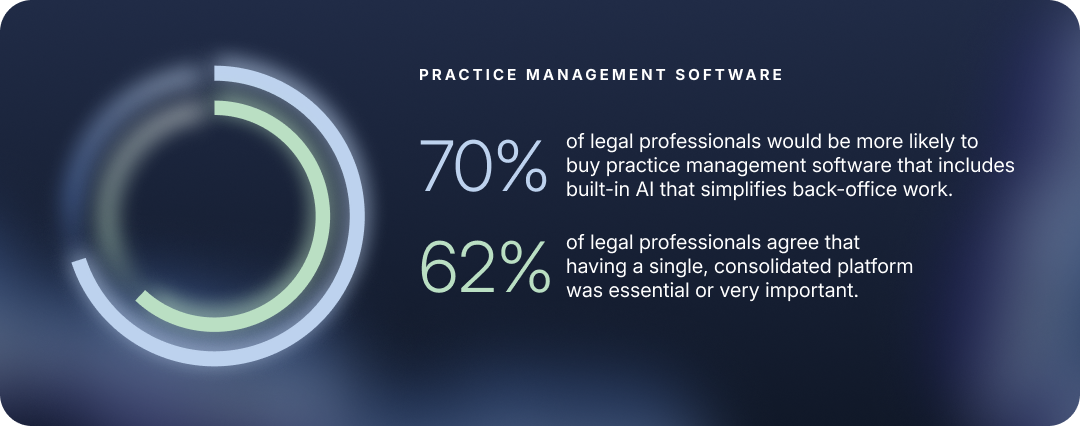
The CosmoLex 2026 Legal Tech Report found that 70% of surveyed legal professionals would be more likely to buy practice management software that includes built-in AI that simplifies back-office work, and 62% said having a single, consolidated platform was essential or very important.
That matters during intake because much of the work firms want to automate is administrative: capturing information from the form, routing it to the right person, running conflict checks, creating new matters, and setting up billing.
These are exactly the kinds of tasks that benefit when information moves forward without a manual handoff. That helps explain why surveyed firms showed more interest in adding AI to a platform they already use than adopting another standalone tool.
As one respondent noted, “We have figured out the products we use and are very unlikely to change…we’re interested in an add-on to that existing platform rather than switching to another AI product.”
The one-platform preference is about more than convenience. It gives law firms a way to keep information moving through the full matter cycle, beginning with intake. Prospect details captured during intake can feed directly into conflict checks, new matters, and billing.
The less information that has to be moved between systems, the more automated intake can feel behind the scenes while the client-facing side stays personal.
Beyond Intake: See How Firms Are Using Legal Tech
In a law firm, client intake is only one place where legal professionals are deciding what technology should handle and what still needs a human touch.
The CosmoLex 2026 Legal Tech Report goes deeper into how firms are using AI and automation, where they’re seeing friction, and what they want legal technology to take off their plates.
Download the full report to get firsthand perspectives from 50 solo and small-firm professionals.
Then see how CosmoLex AI-powered intake helps automate the administrative work around intake while keeping judgment and client connection in your hands.


